

Lithuanian public procurement leaders honoured as the best companies and organisations are announced
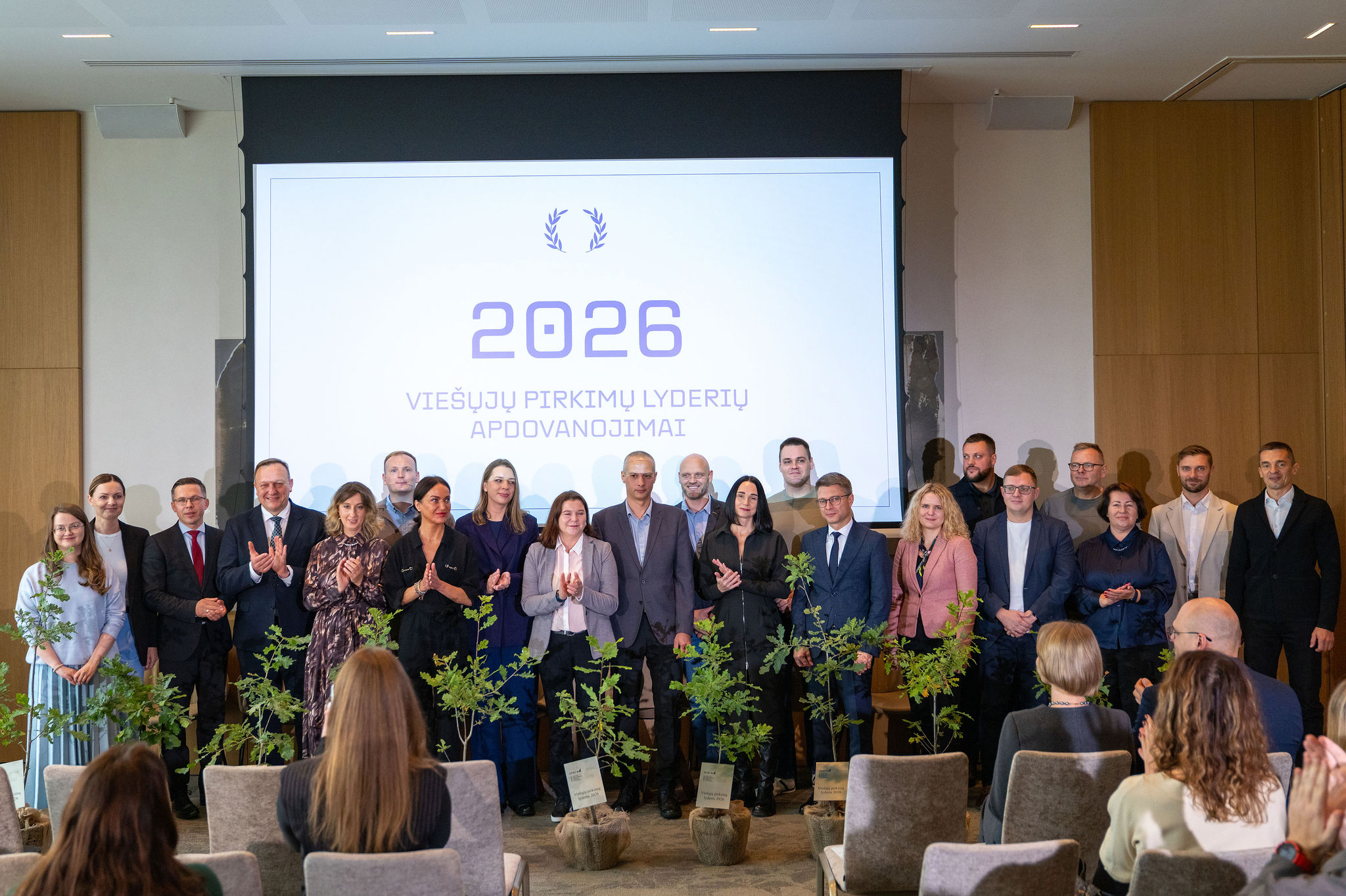
The Ministry of the Economy and Innovation (EIMIN), in collaboration with the Ministry of the Environment and the Public Procurement Service, has unveiled the 2026 public procurement leaders. Nine organisations and companies were recognised for their innovative, environmentally friendly (green) public procurement processes that were carried out in accordance with the best procurement practices. Eleven awards were presented this year, with AB “Miesto gijos” receiving the most – three.
'Public procurement is far more than just a way for the state to acquire the goods or services it needs – it is a significant driver of Lithuania’s economic growth and progress. Every year, by procuring high-quality services, the public sector provides a boost to innovation, encourages businesses to invest, increases productivity, and strengthens competitiveness. In recognising leaders in public procurement this year, we have placed an even greater emphasis on the long-term value of procurement, including innovation, sustainability, and digital solutions. Our aim is therefore to ensure that every public procurement contract becomes a significant investment in a stronger, more modern and more competitive Lithuanian economy”, says Edvinas Grikšas, Minister of the Economy and Innovation.
'Public procurement is one of the ways in which public authorities can contribute to climate targets and create benefits for society. Every green procurement can help to use resources more efficiently, reduce environmental impact, and promote the circular economy. The examples set by this year's winners demonstrate that sustainable solutions can be both innovative and economically beneficial. 'We want such practices to become standard in public procurement. When making decisions today, we must consider their future environmental and societal impact,' says Environment Minister Ieva Andriulaitytė.
‘The examples of procurers selected in the Leaders’ Competition demonstrate what leadership in procurement means. It is not just a matter of following the rules, but also of seeking solutions that are more sustainable, efficient and smart, and that create as much value as possible for society in the long term. Good procurement can reduce pollution, promote the use of renewable energy, implement circular economy principles, and transform everyday consumption habits. It can strengthen cyber security and save hundreds of working hours through the use of digital solutions. ‘We would like to thank you for your genuine leadership, which is measured not by how the procurement was carried out, but by the change it has brought about,’ says Darius Vedrickas, Head of the Public Procurement Service.
The National Energy Regulatory Council won the Best Procurement Practices category for enhancing cyber security maturity in public procurement and bringing institutions together to strengthen their collective knowledge. This organisation has made cyber security an integral part of public procurement planning and risk management.
The Lithuanian Railways (LTG) Competence Centre received an award for digitising the supplier compliance verification process and combining data from different sources into a single, convenient, reliable solution. This digital tool has helped save more than 300 working hours per year, reduced the administrative burden and the risk of errors, and ensured a more consistent and transparent assessment of suppliers.
AB Lithuanian Radio and Television Centre (‘Telecentras’) was recognised for its supplier incentive model, which enables procurement contracts to be implemented more quickly and allows the resulting financial benefits to be shared.
Kaunas City Council won an award for an innovative public procurement solution that links the value of a supplier’s tender to long-term accountability for the outcome. When procuring deciduous tree seedlings and planting services, the council assessed tenders based on price and the additional replanting guarantee provided by suppliers. This model strengthened competition and helped to use public funds more efficiently.
The winners of the Innovative Procurement category were the Klaipėda Republican Hospital, a public institution, which received the award for its leadership in implementing an innovative automated medicine dispensing solution that enhances patient safety and streamlines processes within the healthcare facility. This hospital's innovative system reduces the risk of errors, saves staff time, and represents an important step towards modernising healthcare and improving patient safety.
CPO LT, a public institution, won for its innovative application of artificial intelligence in public procurement. It has developed a solution that enables public procurement prices to be analysed and forecast, compared with market prices and used to facilitate more accurate procurement budget and savings planning.
The Dubysos Aukštupis School in the Šiauliai district won for its innovative artificial intelligence and data analytics solution, which is transforming educational and school management processes, as well as strengthening data-driven decision-making.
AB “Miesto gijos” won the award for their innovative use of wastewater heat in the city’s energy sector. They carried out the procurement of construction works and design services for a project to utilise heat from treated wastewater on behalf of UAB “Šilos”. This project will utilise waste heat, which could meet up to six per cent of Vilnius’s heating demand.
AB “Miesto gijos” also won in another category for an environmentally friendly heat supply solution. The company procured the preparation of a technical design for storage tanks and heat pumps, as well as the installation of equipment at the Salininkai boiler house. This initiative will enable 50–80 per cent of the annual heating demand to be met by renewable sources, thereby increasing the reliability of the heat supply and reducing carbon dioxide emissions by around 1,500 tonnes per year.
AB “Miesto gijos” also won a contract to develop cleaner public transport and hydrogen energy. Under a mandate from UAB “Vilniaus viešasis transportas” (“Vilnius Public transport”), the company procured new low-floor, single-deck, two-axle hydrogen-powered buses.
The Anykščiai District Municipal Administration won the award for implementing circular economy principles in public procurement. It was the first municipality in Lithuania to introduce a reusable tableware system based on circular economy principles, involving over 16 catering establishments and helping to reduce single-use packaging usage.