

Minister Edvinas Grikšas presented the ‘3i’ strategic balanced economy plan
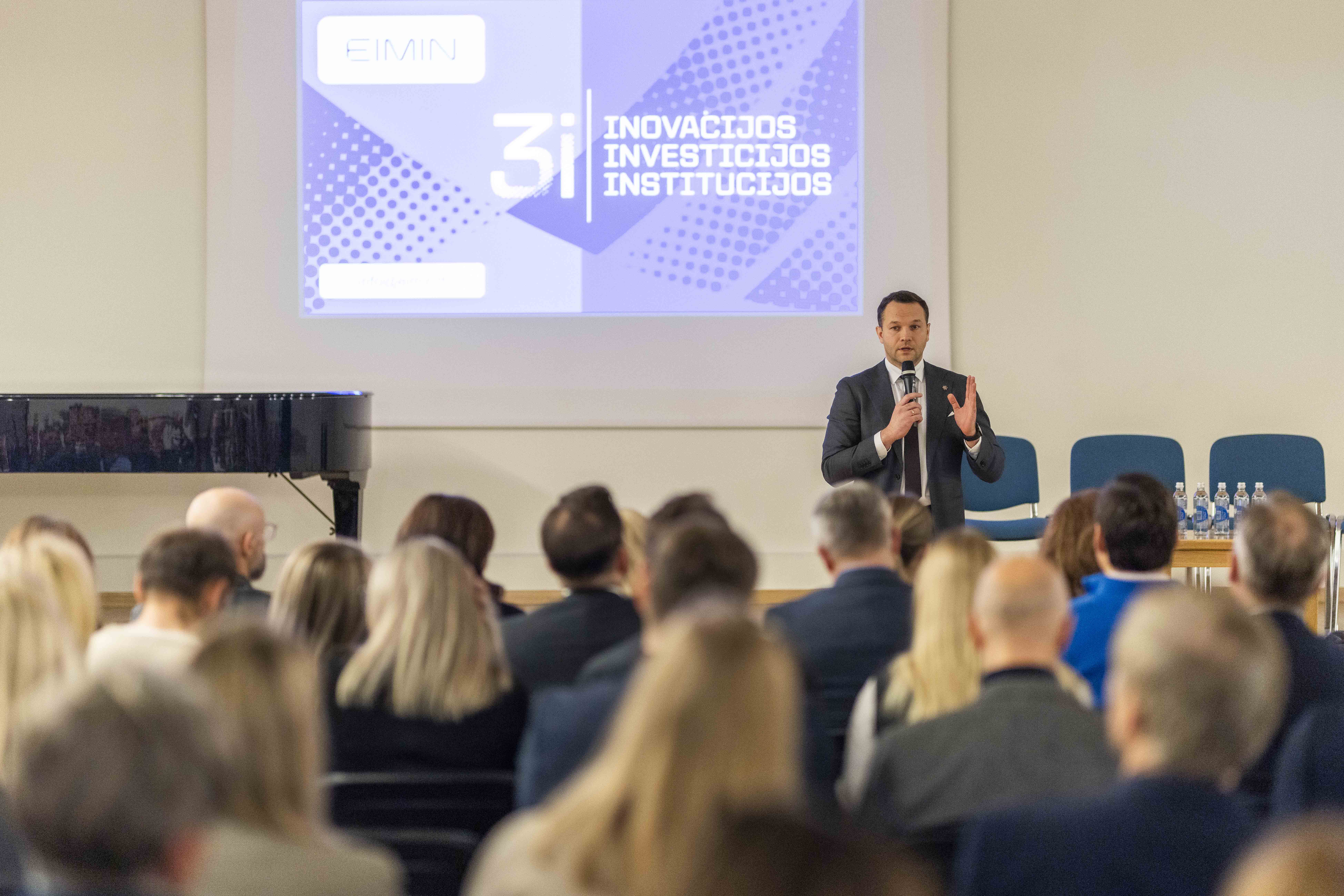
Minister of the Economy and Innovation Edvinas Grikšas and his team presented a new plan for the transformation of the Lithuanian economy. The ‘3i’ plan sets out a clear direction for how Lithuania will move towards balanced, high-value growth. The plan combines three strategic areas: innovation, investment and modern institutions; the goal is for every second workplace in Lithuania to create high added value by 2030.
'The world is experiencing a new phase of competitiveness: a race for investment, talent, innovation and adaptability. These changes affect the entire economy, from industry to the service sector and from the labour market to supply chains. We must respond to this; otherwise, we risk being left behind.
The '3i' plan is our response to these challenges. By investing in innovation, we will create high-value jobs; by strengthening the regions, we will reduce the gap between the capital and the regions; by modernising institutions, we will create an environment in which the state becomes a partner to business rather than an obstacle’, says Edvinas Grikšas.
Innovation is the foundation of a high-value economy
In this area, we will strengthen cooperation between science and business, introduce tax incentives for innovation and expand the ecosystem of start-ups and artificial intelligence. It is planned to achieve that by 2030, spending on research, experimental development and innovation (R&D&I) will double to 2% of GDP and labour productivity will reach 90% of the European Union average.
'We will create an innovation system that turns scientific ideas into businesses, making Lithuanian industry a creator of high added value in areas ranging from biotechnology to defence technology. This is not just about technology; it's about a new way of thinking — the ability to create and adapt solutions right here in Lithuania’, says Paulius Petrauskas, Vice-Minister of the Economy and Innovation.
One of the key steps is the establishment of the first national artificial intelligence centre, LitAI. This centre will facilitate the development and application of artificial intelligence technologies in both the public and private sectors. At the same time, innovation diplomacy will be strengthened to ensure Lithuanian technology companies and start-ups have access to global markets, partners and investments.
Breakthrough sectors will also be developed, including information technology, biotechnology, microelectronics, clean energy and defence. The aim is to increase the life sciences sector's contribution to GDP from 2.2% to 5% by 2030 and to grow the ICT industry's contribution from 3.4% to 5.1%.
Investments: at least 30% should be directed to the regions
The aim in this area is to ensure that economic growth reaches all Lithuanian cities with at least 30% of investments directed to regions. To achieve this, free economic zones (FEZs) and industrial parks will be developed, regional innovation centres will be strengthened and the Spiečius network will be expanded, while traditional industries will be modernised. We will continuously monitor the impact of taxes on businesses and propose tax incentives in response to emerging economic challenges.
'Investing in Lithuania means creating new factories and new opportunities in the regions. Our goal is to create a sustainable economic geography comprising strong regions, modern industry and well-paid jobs throughout Lithuania’, says Waldemaras Urbanas, Vice-Minister of the Economy and Innovation.
The focus will be on high-value foreign investment and the growth of the green industry. We want new investments to create sustainable production from circular economy solutions to resource efficiency technologies.
The plan also provides for measures to retain talent and strengthen competencies, including regulating the talent ecosystem and establishing a flexible retraining system that can quickly respond to labour market needs. This will encourage the arrival of highly qualified professionals and the return of the diaspora.
'Talent is our investment in the future. We must retain people in Lithuania and create conditions for them to grow here, while also attracting new talent. We want everyone here to find opportunities to innovate, improve and contribute to the progress of the Lithuanian economy’, says Vice-Minister of the Economy and Innovation Guoda Burokienė.
Institutions are partners, not obstacles
The plan for modernising institutions is to create a management system that is quick, reliable and focused on partnerships with businesses. The aim is to reduce administrative burden on businesses by 35 per cent by 2027 and double the speed of services. To this end, the 'Once Only' system principle will be introduced enabling companies and individuals to manage all processes in one place.
Plans are also in place to promote GovTech solutions and innovative public procurement enabling the public sector to become a leader in technology implementation. Clear centres of responsibility will be established for institutions to ensure that investor issues are resolved quickly and in a coordinated manner.
'Modernising the state is not just about reducing bureaucracy. It is a change in how we work so that businesses see the state as a collaborative partner rather than an evaluator from the sidelines. To this end, we are creating a fast, transparent and accountable public management system’, says Darius Zailskas, Vice-Minister of the Economy and Innovation.
'We understand that the ‘3i’ plan is only the first step. The main work now awaits us, including focusing on social and economic partners and other institutions that will contribute to its implementation as well as reviewing the appropriations managed by the Ministry and directing them towards implementing the plan. We recognise that this will be the most challenging aspect; yet, we are confident that together we will achieve a breakthrough and witness tangible changes within a few years’, said Chancellor of the Ministry of the Economy and Innovation Inga Steponavičienė.
Last updated: 22-10-2025
Related news:
€10 million investment for regional industrial enterprises to develop sustainable technologies
Lithuanian public procurement leaders honoured as the best companies and organisations are announced
“Spiečius” opens in Mažeikiai: a boost to regional business growth
U.S. defense technology company “Mach Industries” plans to expand in Lithuania